ExamPrepWay Editorial Policy
This policy explains how ExamPrepWay plans, creates, reviews, verifies, updates and corrects educational content.
1. Our Editorial Purpose
ExamPrepWay creates educational resources primarily to help competitive-exam students learn concepts, choose suitable methods, avoid common mistakes and improve practice accuracy. Content should be useful to learners first, rather than being written only for search engines.
2. How We Create Content
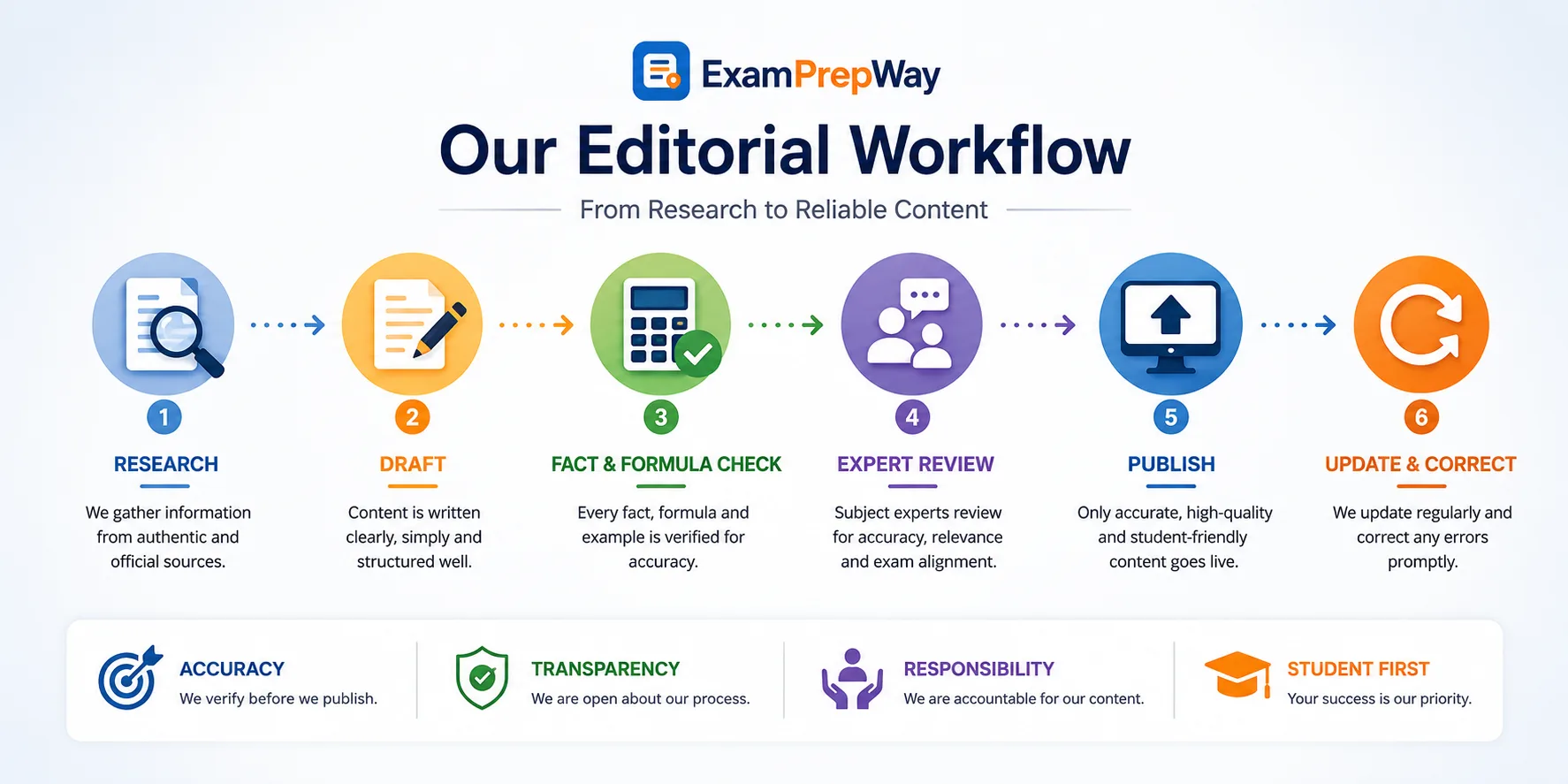
A typical ExamPrepWay content workflow may include:
- Topic and student-intent selection
- Content outline and learning-path planning
- Draft preparation
- Formula and calculation verification where applicable
- English and Hindi/Hinglish review
- Internal-link and topic-cluster checks
- Content-quality and technical QA
- Publication and later updates when needed
The exact workflow may vary depending on whether the page is a concept guide, formula resource, practice set, exam-information page or previous-year-question resource.
3. Authorship
ExamPrepWay educational content is generally published under:
Author: ExamPrepWay Team
“ExamPrepWay Team” represents organisational authorship and the content-production workflow. It does not imply that every article is independently written by one named individual.
Final responsibility for material published on ExamPrepWay remains with ExamPrepWay.
4. Editorial and Content Review
Where a page displays a reviewer attribution, the attribution is intended to indicate that a review step has been completed for that content.
Depending on the topic, review may include:
- Formula and mathematical accuracy
- Worked-example verification
- Concept consistency
- Ambiguous or misleading wording
- Exam relevance
- English-Hindi meaning consistency
- Common-error and shortcut-condition checks
5. Accuracy and Calculation Verification
For quantitative content, formulas and important numerical examples may be checked manually, programmatically or through multiple validation steps before publication.
No publishing process can guarantee that an error will never occur. When a verified error is found, our policy is to correct the content rather than preserve a known mistake.
6. Sources and Previous-Year Questions
Standard mathematical concepts do not always require an external citation. However, stronger verification is expected when content makes claims about a particular exam, year, shift, official syllabus, notification or previous-year question.
Our intended PYQ and sourcing standards are:
- Do not invent or falsely label questions as PYQs.
- Verify exam/year/shift attribution before claiming it.
- Prefer official or credible sources where available.
- Explain educational concepts in our own presentation rather than copying another publisher's article.
- Correct an attribution if reliable evidence shows it is inaccurate.
7. AI-Assisted Tools
ExamPrepWay may use AI-assisted tools within its content and quality-assurance workflow. Such tools may assist with research support, drafting, structure, language improvement, calculation checking, consistency review or other QA tasks.
AI assistance does not replace ExamPrepWay's publishing responsibility. AI-generated output is not treated as an authoritative source merely because it was generated by an AI system.
Material intended for publication should still be evaluated for accuracy, usefulness and consistency with the purpose of the page.
8. English and Hindi/Hinglish Content
ExamPrepWay provides educational content in English and Hindi/Hinglish where available.
Hindi content is not necessarily a word-for-word translation. Common exam terminology such as CP, SP, MP, Profit, Loss, Discount, Ratio and Percentage may remain in English where that improves familiarity and understanding for learners.
The underlying concept, formula and answer should remain consistent across language versions.
9. Internal Linking and Learning Paths
Related resources are linked to help students move through a topic logically. A typical progression may be:
Basics → Formulas → Tricks → Topic-specific guide → Mistakes → Practice
Internal links should support learning and navigation rather than exist only for keyword repetition.
10. Content Updates
A Last Updated date should represent a meaningful change to the page.
Meaningful updates may include:
- A factual or mathematical correction
- A corrected formula, example or answer
- A substantial explanation improvement
- New verified exam information
- A syllabus or exam-pattern change
- A meaningful structural or learning improvement
Dates should not be changed only to make unchanged content look artificially fresh.
11. Corrections Policy
When a possible error is reported or discovered, the intended process is:
- Review the reported issue.
- Verify the correct formula, answer, fact or attribution.
- Correct the page when required.
- Update the modification date when the change is meaningful.
12. Editorial Independence
Educational recommendations should be based on student usefulness and relevance. Commercial relationships should not be used to disguise advertising as independent educational judgment.
If sponsored or promotional content is introduced in the future, it should be identified appropriately.
13. Feedback and Error Reporting
If you find an incorrect formula, calculation, answer, translation or exam attribution, please report the issue and include the relevant page URL and a short explanation.
About ExamPrepWay
Learn more about the platform, its educational purpose and its content approach on our About page.