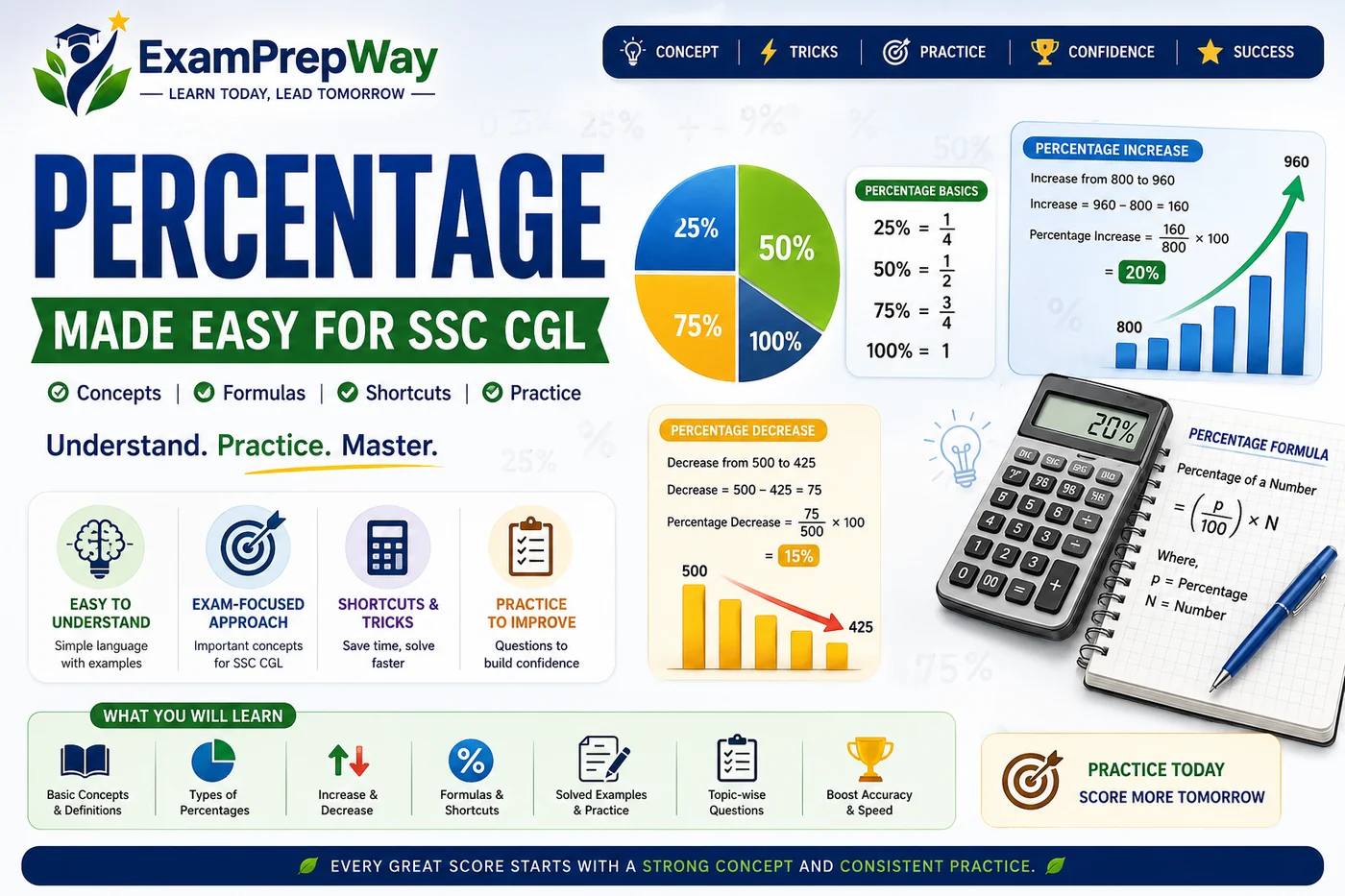
SSC CGL Mathematics
Percentage for SSC CGL – Complete Guide
Learn percentage concepts, formulas, successive changes, reverse percentage and common SSC-style question patterns with worked examples and practice.
What is a percentage?
Percentage means “per hundred.” For example, 30% means 30 out of every 100, or 30/100.
Example: A shop has 500 items and sells 150. The percentage sold is (150 ÷ 500) × 100 = 30%.
Essential percentage formulas
- Percentage: (Part ÷ Whole) × 100
- Value: (Percentage × Total) ÷ 100
- Percentage increase: ((New − Old) ÷ Old) × 100
- Percentage decrease: ((Old − New) ÷ Old) × 100
- Original value after an increase of r%: New value × 100 ÷ (100 + r)
- Original value after a decrease of r%: New value × 100 ÷ (100 − r)
The denominator in a percentage-change calculation is the original value.
Successive percentage changes
The safest method is to use multipliers. An increase of 10% multiplies a value by 1.10; a decrease of 10% multiplies it by 0.90. Therefore, a 10% increase followed by a 10% decrease gives 1.10 × 0.90 = 0.99, or a 1% decrease.
The shortcut a + b + ab/100 is valid when percentage changes are entered with signs: increases are positive and decreases are negative. For +20% followed by −20%, the net change is 20 − 20 + (20 × −20)/100 = −4%.
For two discounts a% and b%, the equivalent discount is a + b − ab/100.
Useful fraction–percentage equivalents
| Fraction | Percentage | Fraction | Percentage |
|---|---|---|---|
| 1/2 | 50% | 1/3 | 33⅓% |
| 1/4 | 25% | 1/5 | 20% |
| 1/8 | 12.5% | 1/10 | 10% |
Example: 75% of 240 = 3/4 × 240 = 180.
Worked PYQ-style examples
The following examples show how percentage concepts are applied in common SSC CGL-style question patterns. Focus on the method used in each example so you can recognize the same structure quickly in practice.
Example 1
If 35% of a number is 70, what is 175% of the number?
35% = 70, so 1% = 2. Therefore, 175% = 175 × 2 = 350.
Example 2
In an election between two candidates, the winner receives 58% of the valid votes and wins by 2,400 votes. Find the total valid votes.
The other candidate receives 42%, so the margin is 16%. Total valid votes = 2,400 × 100 ÷ 16 = 15,000.
Example 3
A price is increased by 20% and then reduced by 20%. Find the net change.
Multiplier = 1.20 × 0.80 = 0.96. The final value is 96% of the original, so the net change is a 4% decrease.
Common mistakes
- Using the new value instead of the original value as the base.
- Adding successive changes without accounting for the changed base.
- Confusing “A is 20% more than B” with “A is 20% of B.”
- Using total enrolled voters when the question specifies valid votes.
Percentage is also the foundation of Profit and Loss for SSC CGL.
Practice questions with answers and explanations
What is 35% of 420?
Answer: 147. Calculate 420 × 35/100 = 147.
40% of a number is 160. Find 75% of the number.
Answer: 300. The number is 160 × 100/40 = 400; 75% of 400 is 300.
A salary rises from Rs. 8,000 to Rs. 10,000. Find the percentage increase.
Answer: 25%. The increase is Rs. 2,000. Thus, 2,000/8,000 × 100 = 25%.
A TV price increases by 10% and then decreases by 10%. Find the net change.
Answer: 1% decrease. Taking the original price as 100 gives 100 × 1.10 × 0.90 = 99.
In a class, 40% are boys. If there are 24 boys, how many students are there?
Answer: 60. Total students = 24 × 100/40 = 60.
After a 25% discount, an item sells for Rs. 450. Find its marked price.
Answer: Rs. 600. The selling price is 75% of the marked price, so MP = 450 × 100/75 = 600.
Find the equivalent discount for successive discounts of 15% and 20%.
Answer: 32%. Equivalent discount = 15 + 20 − (15 × 20)/100 = 32%.
In a two-candidate election, the winner receives 55% of valid votes and wins by 8,400 votes. Find total valid votes.
Answer: 84,000. The margin is 55% − 45% = 10%; therefore, total votes = 8,400 × 100/10.
A person saves 30% of an income, equal to Rs. 3,600. Find the income.
Answer: Rs. 12,000. Income = 3,600 × 100/30.
A is 25% more than B. By what percentage is B less than A?
Answer: 20%. Let B = 100, so A = 125. The difference is 25, measured against A: 25/125 × 100 = 20%.
Practice by Difficulty Level
Build percentage skills in stages instead of jumping directly to tricky questions.
- Level 1 — Basic: percentage of a quantity, converting fractions and decimals to percentages, and simple increase or decrease.
- Level 2 — Standard exam practice: successive percentage change, comparison, reverse percentage and percentage-based word problems.
- Level 3 — Advanced/tricky: multi-step changes, hidden base values, repeated increase/decrease and questions that combine Percentage with Profit & Loss, Ratio or Average.
Why the Percentage Method Works
A percentage is a ratio expressed with a base of 100. That is why converting a situation into a percentage lets us compare quantities even when their original values are different. In increase and decrease questions, always identify the original base first because the percentage change is measured against that base.
For successive changes, the second change acts on the already changed value, not on the original value. This is why an equal percentage increase and decrease do not cancel each other.
SSC CGL Percentage Exam Approach
- Identify the base quantity before calculating the percentage.
- Use fraction-percentage equivalents when they reduce calculation time.
- For successive changes, apply each change to the updated value.
- Estimate first when options are widely separated, then calculate exactly.
- If a question combines Percentage with Profit & Loss, Ratio or Average, identify the percentage relationship before selecting the formula.
Quick Revision Checklist
- Percentage means “per hundred”.
- Percentage = (part ÷ whole) × 100.
- Increase percentage = (increase ÷ original value) × 100.
- Decrease percentage = (decrease ÷ original value) × 100.
- Always check which value is the base.
- Successive changes act on updated values.
- Equal percentage increase and decrease do not normally cancel.
What to Study Next
After revising the concept, continue with Percentage topic practice, review the Profit and Loss guide, check the SSC CGL exam pattern, and use topic-wise practice before moving to mock tests.
Frequently asked questions
These quick answers address common doubts students face while revising Percentage for SSC CGL, especially around starting strategy, successive changes, and safe calculation methods.
How should I start Percentage for SSC CGL?
Begin with part–whole calculations, fraction conversions and percentage change. Then practise reverse and successive percentage questions.
Why are equal increases and decreases not cancelled?
The second change applies to a different base. For example, 100 increased by 20% becomes 120; reducing 120 by 20% gives 96.
Which method is safest for successive changes?
The multiplier method is generally safest because it makes the changing base explicit.